
Clash of Empires: The Battle of Marathon 490 BC
- martinboulter2020
- Oct 16, 2025
- 5 min read
Updated: May 10
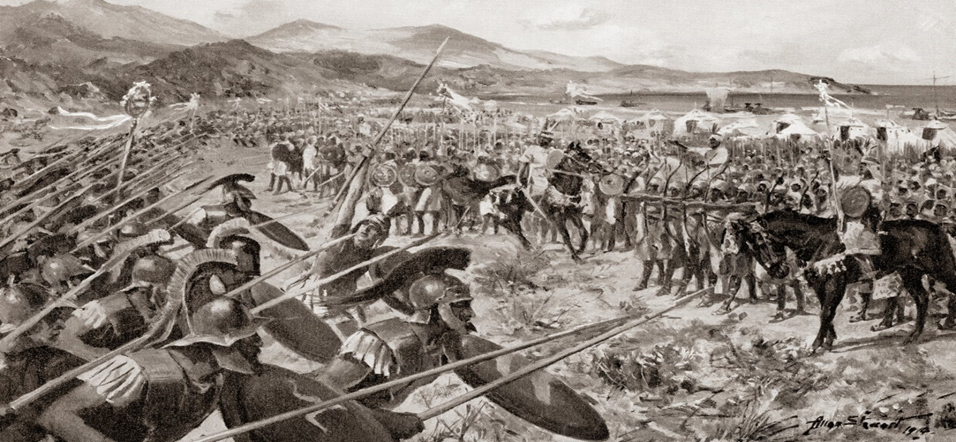
As a prelude to the release of the Clash of Empires Hellenistic game I have decided to do a recreation of the Battle of Marathon (490 BC) using the Hellenistic Battle System rules.
The Battle of Marathon 490 BC
The Battle of Marathon came about because of an Achaemenid Persian expedition to subjugate Greece and punish Athens for giving aid to an Ionian revolt in Asia Minor. As soon as the Athenians learned of the arrival of a seaborne Persian invasion force, they requested aid from Sparta and prepared themselves for battle. The Spartans were willing to send reinforcements, but they were delayed by a religious festival. Under the command of Callimachus and with Miltiades as chief strategist the Athenians and their allies the Plataeans mustered an army about 10,000 strong and took up a defensive position on a narrow plain at the bay of Marathon where the Persians had just disembarked from their ships. The Greek army was made up of heavy infantry only and was at a serious disadvantage against the superior Persian cavalry force. This advantage, however, was thrown away when the Persian commander Datis decided to re-embark a large part of the Persian army including most, if not all, the Persian cavalry. It was his intention to leave a sizeable holding force of about 20,000 troops at Marathon to keep the Greek army pinned down while the rest of the Persian host sailed down the coast to attack Athens. However, Miltiades guessed the Persian plan and counselled that only by an immediate attack and quick victory would the Greeks be able to save Athens. Without delay the Greek army advanced towards the Persians in a long phalanx formation the centre of which was weaker than the flanks and thus by such an arrangement would be able to promote an encircling movement. Such was the speed of the Greek advance that the Persian archers who were the mainstay of their army were given very little time to shoot their arrows. As soon as the two lines met and the melee commenced the Greek centre, as expected, began to give ground while the powerful striking force on each flank pushed back the lightly equipped Persians. Thus, the Persians became outflanked in a double pincer movement and as their line compressed, they lost all cohesion and broke. Panic stricken the Persians ran towards the shore to get to their ships and in the chaos that followed they are reputed to have lost 6,400 killed and many captured. In contrast the Greeks only lost a fraction of their force and crucially they still had time to double back for the defence of Athens. When they saw that their plan had disastrously failed the Persians decided upon a strategic withdrawal back to Asia.
Clash of Empires
Using the Clash of Empires rules the battle strength and capabilities of the belligerents can be shown as follows: -
Athenian Army
Citizen Army type with a Combat Rating (CR) of ❶, which based on the number of army units i.e., 8 converts to a +2 Fighting Bonus (FB). Battle Dice 2D6 (highest scoring die only). Fighting Technique: Hoplite Phalanx which gives the Athenian army a +3 modifier to their Battle Die score. Double modifier if FB greater than that of the opponent. Furthermore, they have no cavalry and a -1 penalty to Initiative due to the unwieldy nature of a phalanx and its vulnerability to flank attack. As chief strategist of the Greek force Miltiades is ranked as a Great Commander and gets 2D6 for Initiative (highest scoring die only).
Achaemenid Persian Army
Feudal Army type with a Combat Rating (CR) of ❶, which based on the number of army units i.e., 16 converts to a +5 Fighting Bonus (FB). Battle Dice 2D6 (highest scoring die only). Fighting Technique: Sparabara which gives the Persian army a +3 modifier to their Battle Die score for Arrow Storm. Double modifier if FB greater than that of the opponent. Due to a tactical error the Persians have deprived themselves of their cavalry along with its +1 to Initiative and a +1 bonus for Deadly Shots. The Persians outnumber the Greeks so get a 1D6 numerical advantage. Finally, the Persian commander Artaphernes is ranked as ordinary and rolls 1D6 for Initiative.
Clash Battle System
After rolling for Initiative the Battle Roll for each army consists of the following procedure:
Roll Battle Dice 2D6 (highest scoring die only)
Plus, Combat Rating (CR) to Fighting Bonus (FB) (conversion dependent upon number of units).
Plus, Battle Bonus calculation determined by Army Type and FB.
Plus, Advantage Dice (representing a numerical, tactical or other special advantage)
Highest score wins and the difference between the two Battle Rolls determines the number of casualties.
Combat Rating to Fighting Bonus Conversion and Casualty Tables not shown.
Ancients Battle Log
Domain = Athens
Battle = Marathon Date: Year 20 Turn 8
Initiative | Battle Dice (Modifiers) | Combat Rating to Fighting Bonus | Battle Bonus Normal (Enhanced) | Battle Advantage Dice | Total Score |
2D6 -1 4 and 6 (Highest die only)
6 - 1 = 5
| 2D6 (+3/+6) Hoplite Phalanx 4 and 4 (Highest die only)
4+3 = 7
| ❶ x 8 = +2 FB | Evens Dice
1D3(1D6) 1D6 = 6
| Tactical Advantage 1D6
= 5 | 7+2+6+5 = 20 |
Domain = Achaemenid Persia
Initiative | Battle Dice (Modifiers) | Combat Rating to Fighting Bonus | Battle Bonus Normal (Enhanced) | Battle Advantage Dice | Total Score |
1D6 = 3
| 2D6 (+3/+6) Sparabara 2 and 1 (Highest die only)
2+6 = 8
| ❶x 16 = + 5 FB
| No odds or evens
1D3(1D6) 1D3 = 1
| Opponent outnumbered 1D6
= 2 | 8+5+1+2 = 16 |
Battle Bonus Calculation Table not shown.
Battle Bonus determined by Army Type and Fighting Bonus (FB).
(#D#) = Enhanced Battle Bonus on odds or evens Battle Dice.
Note: - Twenty years after the end of the Athenian ‘tyranny’ Athens is forced to defend itself against Persia on the plain of Marathon. Despite having no cavalry, the Greeks roll 6 for Initiative which is downgraded to 5. After winning Initiative and gaining a 1D6 Tactical Advantage the Greeks advance rapidly towards the Persian host. An enhanced Battle Bonus of 6 contributes to a winning Battle Roll against the Persians whose numerical advantage was to no avail. The Greeks score 20 and the Persians 16. This gives a difference of 4 which on the Casualty Table equates to 50% losses for the Persians (8 units) and 15% for the Greeks who lose 1 unit of troops killed or wounded.

Sources
Boulter, M. L. 2009/2025: Clash of Empires: The Hellenistic World. Silurian War Games Ltd.
Dupuy, R. E. and Dupuy, T. N. 1993: The Collins Encyclopaedia of Military History. Harper Collins Publishers.
Mellersh, H.E.L. 1995: Chronology of the Ancient World, 10,000 BC – AD 799. Helicon Publishing Ltd.
Scott, J.C.1977: The Greek and Persian Wars 500-323 BC. Osprey Publishing Ltd.
Article Front Page Picture
The Battle of Marathon, 490 BC, during the first Persian invasion of Greece, fought between Athens, aided by Plataea, and the Persian Empire. After the painting by Allan Stewart, (1865-1951). From Hutchinson’s History of Nations, published 1915. After Alamy (IY04212203).


Часом знаходжу ці джерела випадково, іноді хтось скине в чат, іноді сам зберігаю “на потім”. Частину переглядаю рідко, частину — коли шукаю щось локальне чи нестандартне. Вони різні: новини, огляди, думки, регіональні стрічки. Я не беру все за правду — скоріше, для порівняння та пошуку контрасту між подачею. Можливо, хтось іще знайде серед них щось цікаве або принаймні нове. Головне — мати з чого обирати. Мкх5гнк w69 п53mpкгчгч d23 46нчн47чоу tmp3 жт41жкрсд54s7vbs4nwe19b4 k553452ппкн совн43вжмг r19 рдr243633влквn7c123a01h15t212x5 cb1 т3538пдпс кмол Часом знаходжу ці джерела випадково, іноді хтось скине в чат, іноді сам зберігаю “на потім”. Частину переглядаю рідко, частину — коли шукаю щось локальне чи нестандартне. Вони різні: новини, огляди, думки, регіональні стрічки. Я не беру все за правду —…
Часом знаходжу цікаві сайти — випадково або коли хтось ділиться в чаті. Частину зберігаю про запас, іноді повертаюсь до них при нагоді. Тут є різне — новини, блоги, локальні стрічки чи просто незвичні штуки. Деякі переглядаю рідко, деякі — коли хочеться вийти за межі звичних джерел. Поділюсь добіркою — може, хтось натрапить на щось нове: Мкх5гнкw69п53mpкгчгч d23 46нчнчоу жт41жкрсд54s7vbs4nwe19b4k553452ппкн совн43вжмг r19 r243633влквn7c123a01h15t212x5 cb1 т3538пдпс кмол Щодо загальної інформації — іноді буває корисно мати кілька додаткових ресурсів під рукою. Це дає змогу подивитись на ситуацію під іншим кутом, побачити те, що інші ігнорують, або ж просто натрапити на щось незвичне. Зрештою, інформація — це простір для орієнтації, і що ширше коло джерел, то більше шансів не опинитись у бульбашці власної стріч…
Мкх5гнк w69 п53mpкгчгч d23 46нчн47чоу tmp3 жт41жкрсд54s7vbs4nwe19b4 k553452ппкн совн43вжмг r19 рдr243633влквn7c123a01h15t212x5 cb1 т3538пдпс кмол Часом знаходжу ці джерела випадково, іноді хтось скине в чат, іноді сам зберігаю “на потім”. Частину переглядаю рідко, частину — коли шукаю щось локальне чи нестандартне. Вони різні: новини, огляди, думки, регіональні стрічки. Я не беру все за правду — скоріше, для порівняння та пошуку контрасту між подачею. Можливо, хтось іще знайде серед них щось цікаве або принаймні нове. Головне — мати з чого обирати.